
KHDA student protection framework: What Dubai private school families should know
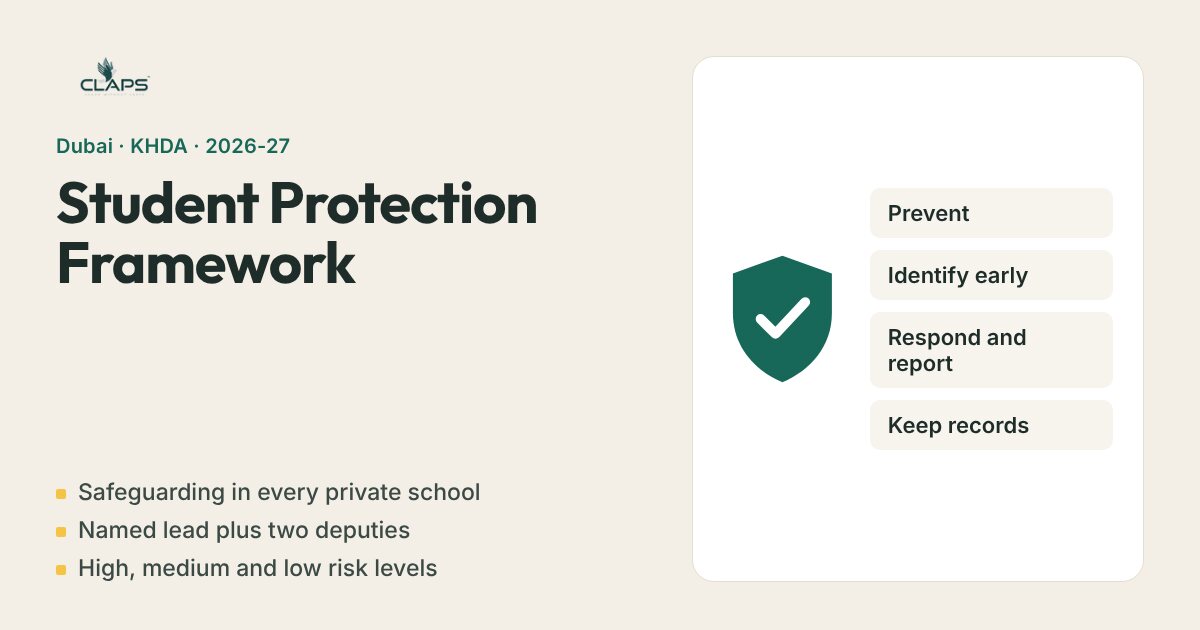
Dubai’s KHDA has introduced a new safeguarding and learner protection framework for private education institutions, including schools, early childhood centres, higher education and vocational institutes. For families, the key point is simple: every KHDA-permitted institution must have clearer reporting routes, trained safeguarding roles and defined response timelines when a child or learner may be at risk.
Applicable to the 2026-27 academic year, this update affects learners in all KHDA-permitted private educational institutions in Dubai. That includes Indian curriculum schools such as CBSE and ICSE schools, British, IB and other international schools, early childhood centres, higher education institutions and technical or vocational institutes. It is not an exam syllabus change, but it can affect daily school life, attendance follow-up, online safety, trips, transport and how concerns are reported.
What happened?
Emirates 24|7 reported that KHDA had launched a unified student protection framework for Dubai’s private schools and wider private education sector. The official KHDA page confirms the Policy Framework for Safeguarding and Learner Protection in Dubai’s Private Educational Institutions and says it sets a regulatory standard across private education.
The framework covers both physical and virtual learning environments. It focuses on prevention, early identification of concerns, effective response, reporting, record-keeping and continuous improvement. In practice, this means schools must move from informal handling of concerns to a documented system with named roles, clear thresholds and external reporting routes where required.
Who is affected?
- Students in KHDA-permitted private schools in Dubai, including Indian curriculum schools following CBSE or ICSE/ISC.
- Children in early childhood centres regulated by KHDA.
- Learners in higher education and TVET institutions, including learners aged 18 or above.
- Parents, guardians and custodians, who are expected to know the reporting route and keep contact details updated.
- School leaders, teachers, counsellors, transport staff, activity providers, volunteers and other adults working with learners.
The three risk levels explained
KHDA’s FAQ explains that safeguarding concerns are assessed as high, medium or low risk. These levels are not labels for students; they are decision-making thresholds to help trained staff decide how urgent the response must be.
- High risk: there is a significant and immediate threat. The school must take urgent protective action and refer without delay to the relevant authority or emergency service, such as CDA, Dubai Police or ambulance, while informing KHDA.
- Medium risk: there is no immediate threat, but there is a meaningful risk of harm if the situation does not improve. The concern must be escalated to CDA within 24 hours and KHDA must be informed.
- Low risk: the concern is limited at that point, but still needs support, monitoring and review. KHDA must be informed within 72 hours.
What changes inside schools?
Every institution must have a Child Protection Coordinator or Designated Safeguarding Lead, known as CPC/DSL, plus at least two deputies. The head of the institution remains accountable for the safeguarding system, but KHDA separates that accountability from day-to-day safeguarding case decisions.
KHDA also describes three safeguarding team tiers. Tier 1 is the core team led by the CPC/DSL and deputies. Tier 2 brings in relevant staff such as counselling, inclusion, health, pastoral, digital or operations teams. Tier 3 looks at wider patterns, policies, risks and improvement, with reports to governance at least once a term.
What it means for parents in practice
- Ask your child’s school for the name and contact details of the CPC/DSL and deputies.
- Read the school’s safeguarding, anti-bullying, attendance, behaviour and digital safety policies when they are shared or updated.
- Keep your mobile number, email and emergency contacts current in the school system.
- Report worries early. You do not need proof before speaking to a trusted teacher, counsellor or CPC/DSL.
- If a learner is in immediate danger, call 999. For child protection concerns, KHDA’s FAQ also lists the CDA Child Protection Hotline as 800988.
- If you are unhappy with how a concern is handled, KHDA lists 8005432 and info@khda.gov.ae as contact routes.
What students should do
Students should know that speaking up is part of staying safe, not “complaining”. If something feels unsafe, if bullying is happening online or offline, or if a friend seems at risk, tell a trusted adult at school. Do not promise to keep harmful situations secret. The responsibility to protect learners belongs to adults and the institution.
Family checklist for this term
- Save the school CPC/DSL contact in your phone.
- Ask your child: “Which adult would you speak to if you felt unsafe?”
- Review online safety rules at home, especially private chats, gaming, AI tools and social media.
- Check absence reporting rules and inform the school promptly if your child is ill or away.
- For trips, transport and extracurricular activities, confirm supervision arrangements and emergency contacts.
- If your child is preparing for exams, keep wellbeing discussions separate from marks and performance pressure.
If your child needs help understanding school safety rules or balancing wellbeing with academics, a teacher, counsellor or structured learning mentor can help. Claps Learn families may also discuss study routines with tutors, but safeguarding concerns must always be reported through the school or official emergency routes.