
Dubai schools: what the new five-day absence reporting rule means
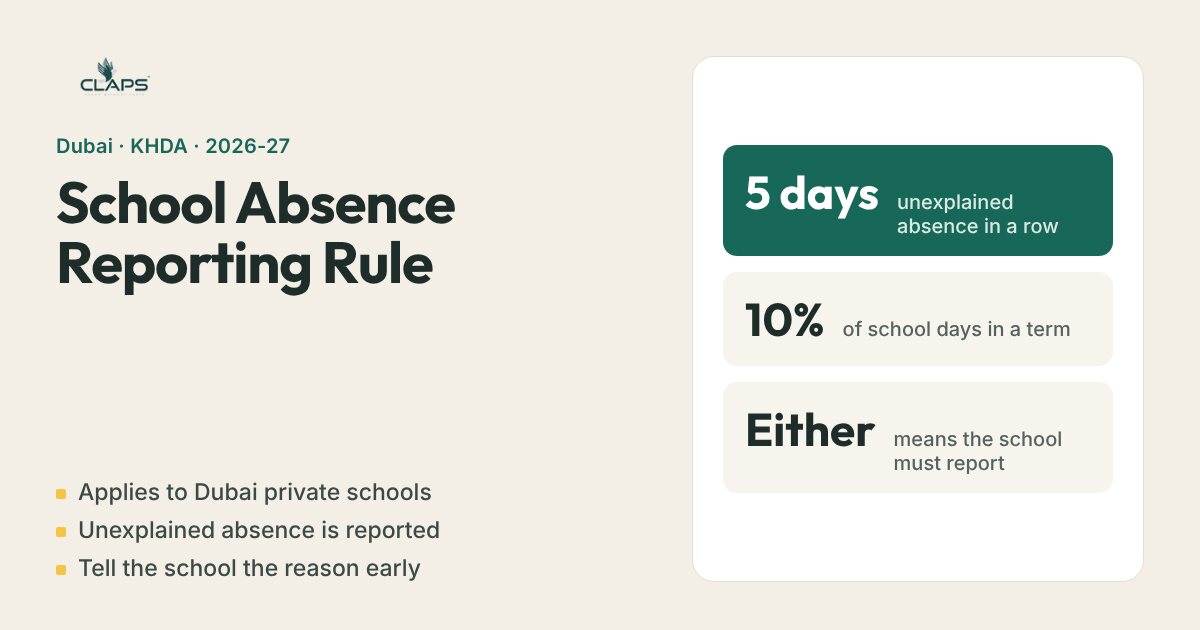
Dubai private schools have a new absence-reporting requirement under KHDA’s safeguarding framework. If a learner has five consecutive school days of unjustified absence, or unexplained absences adding up to 10% of a term, the school must notify KHDA. The rule is about learner safety and early support, not just attendance discipline.
Khaleej Times reported on 16 November 2026 that Dubai private schools now face clearer reporting requirements for student absence. We checked this against KHDA’s official Policy Framework for Safeguarding and Learner Protection in Dubai’s Private Educational Institutions and its official FAQ. The rule applies in the 2026-27 academic year to learners in KHDA-permitted private schools in Dubai, across school phases and curricula, including Indian, British, IB and other international schools.
What has changed?
KHDA’s framework requires schools to treat unexplained or repeated absence as a possible safeguarding signal. Schools must have attendance policies, reliable daily records and a process to follow up with families. The important change for parents is that certain absence patterns must now be reported to KHDA, instead of being handled only inside the school.
- A school must notify KHDA if a learner has five consecutive school days of unjustified absence.
- A school must also notify KHDA if sporadic unexplained absences add up to 10% of the total days in a term.
- If staff believe a learner may be at risk, they do not need to wait for either threshold before escalating the concern.
- Schools must record communication with parents, guardians or custodians and document agreed follow-up actions.
Who does it affect?
This is a UAE-Dubai school policy issue, not a CBSE, ICSE, IB or Cambridge exam rule. It affects learners enrolled in Dubai private educational institutions permitted by KHDA. For school-age children, the practical impact is on attendance follow-up, parent communication and safeguarding records. For learners aged 18 or above, the official FAQ says institutions should normally speak directly with the learner, while involving family with consent or where there is a risk of harm.
- Board: UAE / KHDA-regulated Dubai private schools.
- Academic year: 2026-27, based on the current KHDA framework and the 16 November 2026 news report.
- Classes: all school phases in Dubai private schools; parents should check the school’s own attendance policy for phase-specific procedures.
- Not confirmed as an exam-board change: it does not change CBSE, ICSE, ISC, IB, IGCSE or Cambridge exam attendance rules by itself.
What this means in daily school life
Parents should not read the rule as a ban on genuine illness or unavoidable absence. The key word is unjustified or unexplained. If a child is ill, travelling for an emergency, attending a medical appointment or facing a serious family situation, the safest approach is to inform the school early and keep evidence where appropriate. Each school may define accepted documents in its attendance policy, so check the official notice or school circular rather than guessing.
- Tell the school on the first day of absence through the approved channel, such as the parent app, email or reception number.
- Give a clear reason. Avoid vague messages such as “not coming today” when there is a genuine reason.
- If absence may continue, update the school before it reaches five consecutive school days.
- If your child has repeated short absences, late arrivals or clinic visits, speak to the class teacher or wellbeing team early.
- For planned travel, ask the school in advance whether the absence will be authorised.
Student and parent checklist
The best response is a simple attendance routine at home. This protects the child, reduces confusion, and gives the school a clear record if KHDA reporting is required.
- Save the school’s attendance email, hotline and parent-portal login in both parents’ phones.
- Check every morning that absence has been reported if the child is not attending.
- Keep medical certificates, appointment slips or travel/emergency documents where relevant.
- Ask your child what they missed academically and request catch-up work when the absence is longer than a day or two.
- If absence is linked to anxiety, bullying, learning stress or health issues, request a meeting with the school counsellor, wellbeing lead or safeguarding lead.
- Do not wait until term-end reports to discuss attendance patterns.
Questions to ask your school now
Every KHDA-permitted school should align its own attendance and safeguarding procedures with the framework. Parents can ask practical questions without treating the matter as a complaint.
- What is the school’s approved absence-reporting channel?
- Which absences are authorised, and what proof is required?
- When will parents be contacted if a child is absent or late?
- Who is the Child Protection Coordinator or Designated Safeguarding Lead?
- How will the school support a child who has missed learning because of illness or other valid reasons?
For families preparing for board exams or internal assessments, the practical message is to keep attendance communication timely and written. If your child needs help catching up after absence, a structured study plan with school teachers or a provider such as Claps Learn can help, but safeguarding and attendance reporting must always follow the school and KHDA process.