
7 Signs Your Child Needs a Personal Tutor (Not Just School)
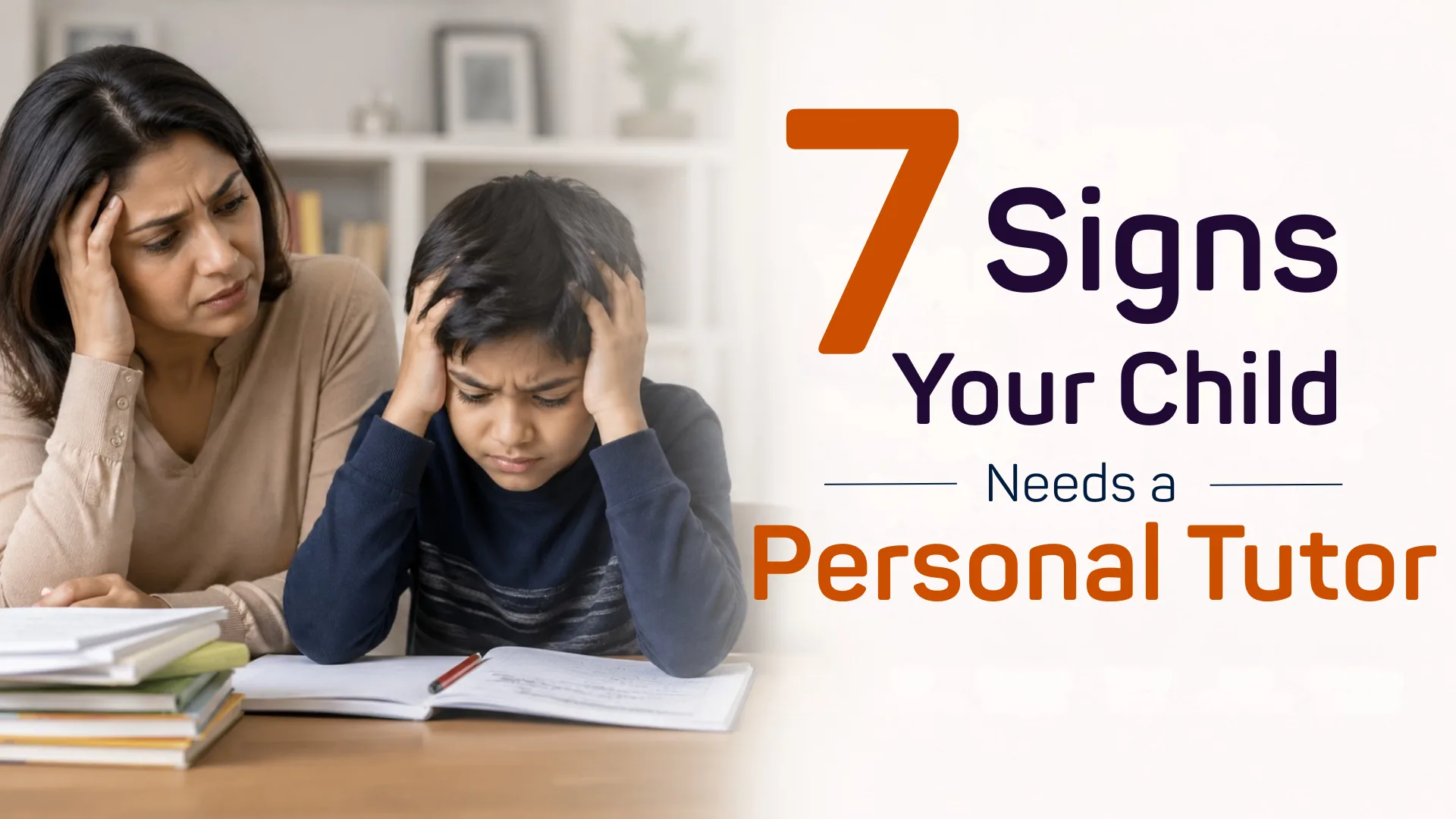
Your child comes home with their report card. Or you see the anxiety in their eyes before a math test. Or the teacher sends a note saying they seem "disengaged" in class. And you wonder: is this just a phase, or do they actually need extra help? As parents, it is tempting to wait and hope. Maybe the teacher will notice. Maybe things will improve on their own. Maybe this is just how some kids are with math. But here is the uncomfortable truth: struggling students rarely figure it out alone. And the longer a learning gap exists, the harder it becomes to close. A concept that should have been mastered in Class 7 but wasn't becomes an obstacle to understanding Class 10 material. The gap doesn't close — it compounds. So how do you know when your child genuinely needs a personal tutor? Here are seven clear, honest signs that it is time to consider 1-on-1 support.
Sign 1 — Declining or Consistently Low Grades
Not every low grade means your child needs a tutor. But a pattern is different from a one-off bad day. Look for: grades dropping across consecutive terms, consistent scores below class average in specific subjects, report cards that show the same subject struggling every term, and a significant gap between what your child seems to 'understand' and what their grades show.
Sign 2 — Anxiety or Emotional Resistance Toward a Subject
When your child dreads a particular class — not because they are lazy, but because they genuinely feel lost — that is a serious warning sign. Watch for physical symptoms before school or exams, crying about homework or tests, statements like 'I can't do math,' and mood changes around school days.
Sign 3 — Difficulty Keeping Up With Classmates
You may not see report cards that flag this, but you hear it in different ways: 'The teacher goes too fast.' 'Everyone else understood but me.' In a class of 40 students, a teacher cannot slow down for every child who is stuck. A personal tutor can give your child the individual attention to catch up.
Sign 4 — Significant Gaps in Foundational Knowledge
This one is particularly common in Mathematics and languages. Concepts in these subjects build on each other. If your child missed a foundational concept in Class 6, they will struggle with every subsequent class topic that relies on it. A tutor who can diagnose specific gaps and fill them systematically is uniquely valuable.
Sign 5 — Declining Motivation and Engagement
When struggling students stop trying, it is often misread as laziness. The truth is almost always the opposite: they have learned that trying leads to failure. Watch for incomplete assignments, loss of interest in hobbies, 'I don't care' attitudes, and screen time increasing while study time decreases.
Sign 6 — Your Child's Teacher Recommended Extra Help
If your child's teacher has directly suggested tuitions or extra support, take that recommendation seriously. Teachers see your child in a structured learning environment every day. Ask specific questions: What concepts is my child struggling with? Is this recent or long-standing? What approach would help most?
Sign 7 — Major Academic Transitions Are Approaching
Certain moments are higher-risk: Class 5 to 6 (when subjects become specialized), Class 8 to 9 (when Science splits and difficulty jumps), Class 10 board exam year, and Class 11-12 (the sharpest difficulty increase). Starting tutoring before the crisis hits is always better than waiting.
What to Do If You Recognize These Signs
Seeing these signs does not mean your child is a failure. It means they need support — the kind that a classroom of 40 students simply cannot provide.
- Have an honest conversation with your child without judgment
- Talk to their teacher for specific information
- Get a diagnosis, not just a tutor — understand the root cause
- Choose 1-on-1 tutoring for individual attention
- Start with a free demo to find the right match
FAQ: Signs Your Child Needs a Tutor
Is it normal for children to struggle in school?
Some level of challenge is normal and healthy. But persistent struggling across multiple terms, in specific subjects, accompanied by anxiety or avoidance, is a signal that extra support is needed.
At what class should I consider hiring a tutor?
Tutoring can be beneficial from Class 1 onwards. However, Class 5-6, Class 8-9, and Class 10-12 are the most common intervention points.
Will hiring a tutor make my child dependent?
A good tutor does the opposite — they work themselves out of a job. The goal is to build your child's independence, confidence, and self-directed learning skills.
How quickly can I expect to see improvement?
Some parents see a shift in confidence within 2-3 sessions. Measurable grade improvement typically shows within one academic term. The key is consistency and choosing the right tutor.