
Electricity and Magnetism Class 10 Physics | Claps Learn
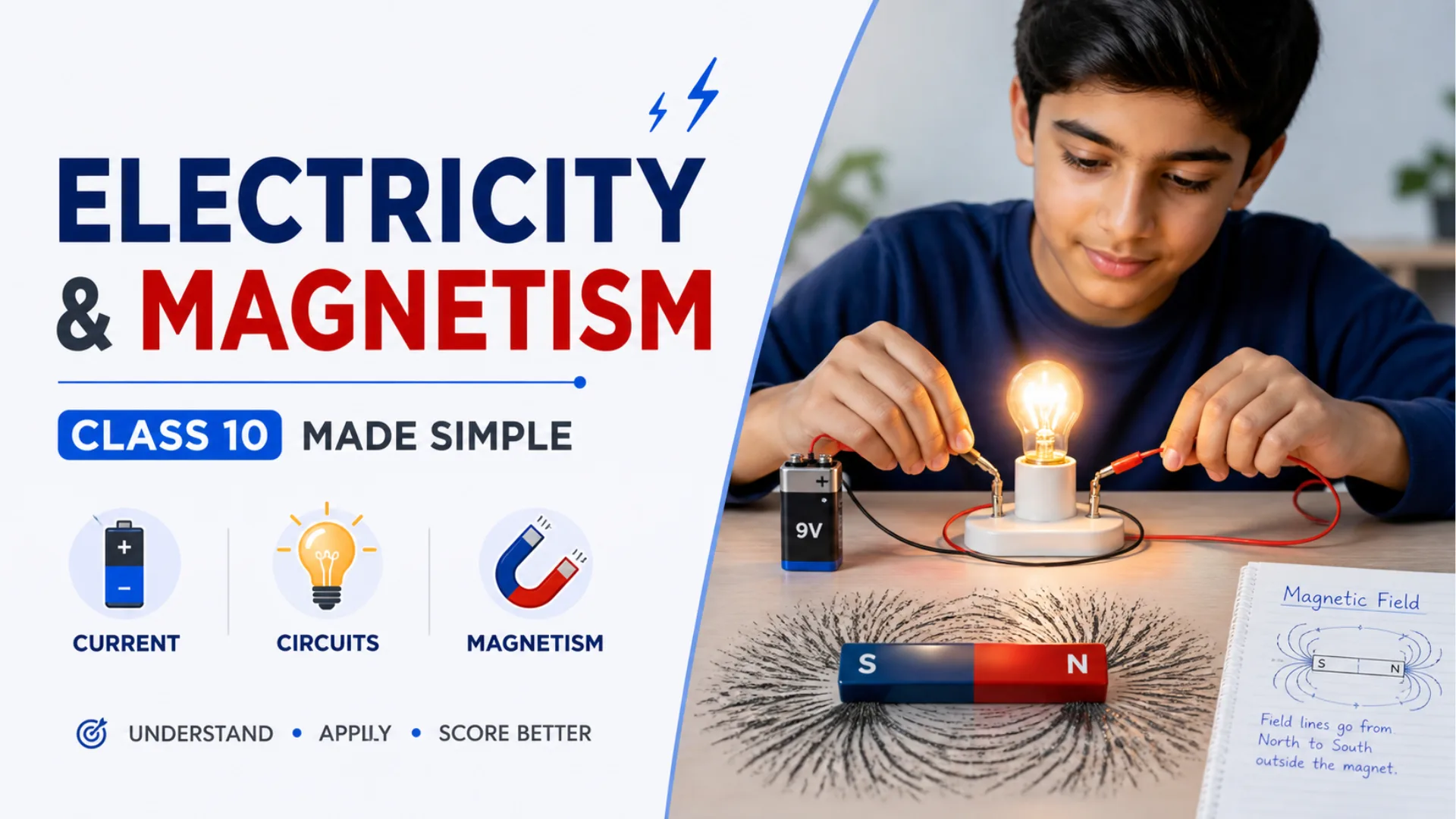
The lights in your home, the phone charger on your desk, the refrigerator keeping your food fresh — all of these run on principles you need to master for your Class 10 physics exam.
Electric Current — The Flow of Charges
What is Electric Current?
Electric current is the ordered flow of electric charges (usually electrons) through a conductor. Electric Current (I) = Charge (Q) / Time (t): I = Q / t. Unit: Ampere (A), where 1 A = 1 Coulomb/second.
Electric Potential and Potential Difference
For charges to flow through a wire, there needs to be a potential difference (voltage). Potential Difference (V) = Work done (W) / Charge (Q): V = W / Q. Unit: Volt (V).
Ohm's Law — The Most Important Formula in Electricity
At constant temperature, the current flowing through a conductor is directly proportional to the potential difference across its ends. V = IR. Where: V = Potential difference (Volts), I = Current (Amperes), R = Resistance (Ohms, symbol Omega).
Factors Affecting Resistance
R = rhoL / A. Where: rho (rho) = resistivity of the material, L = length of the conductor, A = cross-sectional area. Longer wire = higher resistance. Thicker wire (larger area) = lower resistance.
Electric Circuits — Series and Parallel
Series Circuit
Same current flows through all components: I total = I1 = I2 = I3. Total voltage is sum of individual voltages: V total = V1 + V2 + V3. Total resistance is sum of individual resistances: R total = R1 + R2 + R3.
Parallel Circuit
Same voltage across all branches: V total = V1 = V2 = V3. Total current is sum of branch currents: I total = I1 + I2 + I3. Total resistance is less than the smallest individual resistance: 1/R total = 1/R1 + 1/R2 + 1/R3.
Magnetic Effects of Electric Current
When electric current flows through a straight wire, it produces a magnetic field in concentric circles around the wire. Right-Hand Thumb Rule: Curl the fingers of your right hand around the wire with the thumb pointing in the direction of current flow. Your fingers show the direction of the magnetic field.
Electromagnetic Induction
Michael Faraday discovered in 1831 that moving a magnet through a coil (or changing the magnetic field around a coil) induces an electric current in the coil. Fleming's Right-Hand Rule: Stretch your thumb, first finger, and middle finger so they are all perpendicular. First finger: magnetic field. Thumb: motion of conductor. Middle finger: induced current.