
Newton's Laws of Motion for Class 9 | Claps Learn
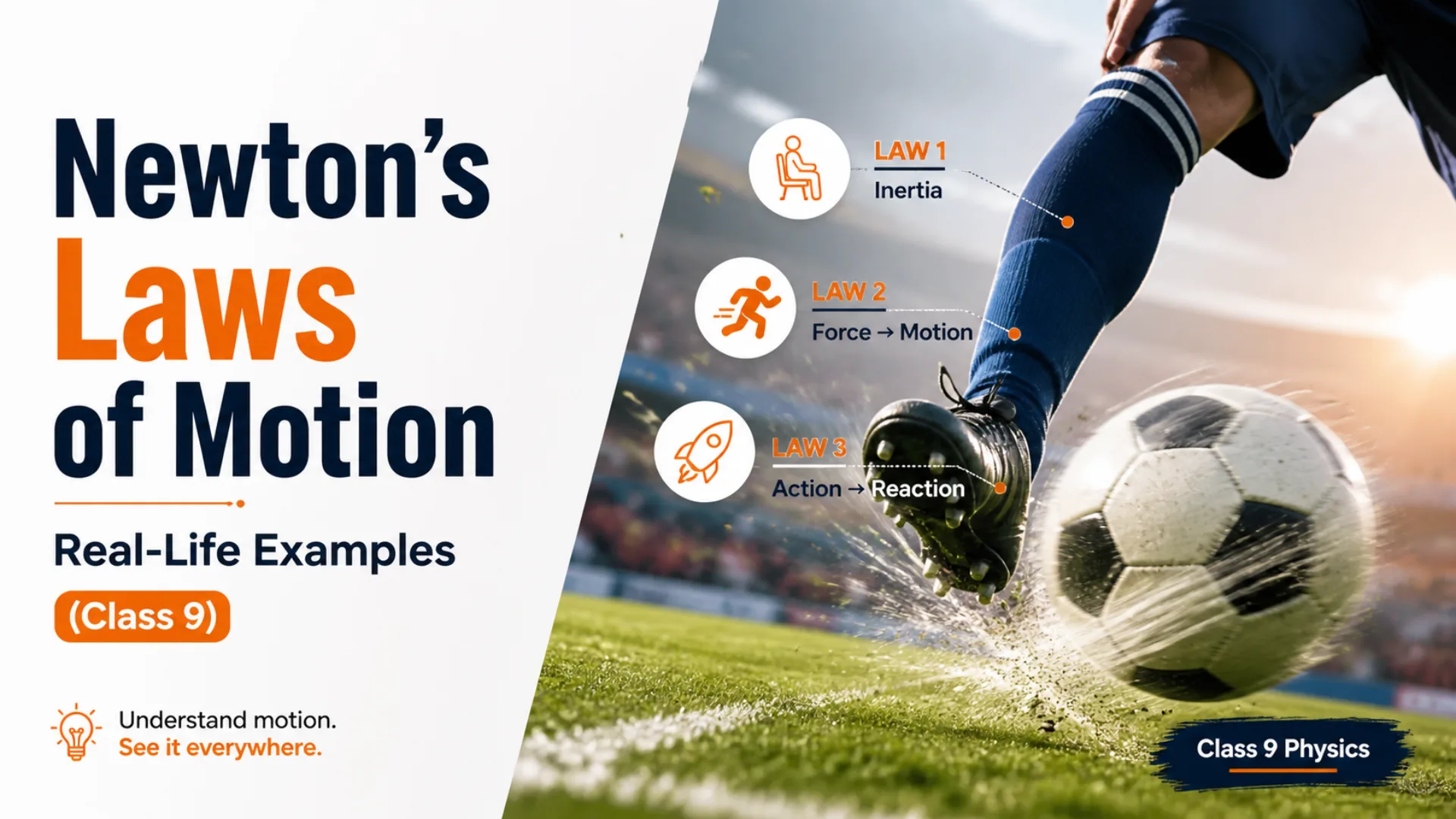
Newton's Laws of Motion appear in every Class 9 physics syllabus across CBSE, ICSE, and IB boards. They are not just theoretical concepts — they explain every physical interaction you observe in daily life.
Newton's First Law of Motion — The Law of Inertia
The Statement
An object remains at rest or in uniform motion in a straight line unless acted upon by an external force.
Key Concept — Inertia
Inertia is the natural tendency of an object to resist changes in its state of motion. Mass is the measure of inertia — more mass means more inertia.
Real-World Examples
- Passenger lurching forward when a bus brakes suddenly
- A book sliding off a table when the tablecloth is yanked quickly
- A magician pulling a tablecloth from under dishes
- Dust being removed from a carpet by beating it
Newton's Second Law of Motion — The Law of Acceleration
The Statement
The rate of change of momentum of an object is directly proportional to the applied force and takes place in the direction in which the force acts. In practical terms: Force equals mass times acceleration.
The Formula
F = ma. Where: F = Force (measured in Newtons, N), m = mass (measured in kilograms, kg), a = acceleration (measured in metres per second squared, m/s squared). One Newton is the force required to accelerate a mass of 1 kg at a rate of 1 m/s squared.
Real-World Examples
- Pushing an empty shopping cart vs a loaded one
- A cricket ball vs a tennis ball hit with the same force
- A car accelerating on a highway
- Kicking a football
Newton's Third Law of Motion — Action and Reaction
The Statement
For every action, there is an equal and opposite reaction. The action and reaction forces: Are equal in magnitude, Act in opposite directions, Act on different objects (not on the same object).
Real-World Examples
- Rocket propulsion
- Walking
- Swimming
- A balloon releasing air
- Recoil of a gun
Quick Reference Summary Table
- First Law: Objects resist changes in motion (conceptual)
- Second Law: F = ma — force causes acceleration
- Third Law: Action = reaction (equal, opposite, different objects)