
Calculus Limits and Derivatives in Class 11 | Claps Learn
The key to understanding calculus lies in understanding one concept before all others: the limit. A limit asks a deceptively simple question: as a variable gets closer and closer to a value, what does the function get closer to?
Why Limits Are the Doorway to Calculus
Every student who has ever been curious about how scientists predict planetary motion, how economists model growth, or how engineers design bridges has brushed against calculus. And yet, for Class 11 students encountering it for the first time, calculus can feel like an impenetrable wall.
The key to understanding calculus lies in understanding one concept before all others: the limit.
What Is a Limit?
Consider the function f(x) = (x^2 - 4) / (x - 2). If you substitute x = 2 directly, you get 0/0, which is undefined. But what happens as x gets very close to 2? As x = 2.1: f(2.1) = 4.1. As x = 2.01: f(2.01) = 4.01. The function is clearly approaching 4 as x approaches 2. We write: lim(x->2) of (x^2 - 4) / (x - 2) = 4.
Standard Limit Results You Must Memorise
- lim(x->0) sin x / x = 1 (with x in radians)
- lim(x->0) (1 + x)^n = 1 + nx (binomial approximation)
- lim(x->0) (e^x - 1) / x = 1
- lim(x->0) (a^x - 1) / x = log a
- lim(x->0) tan x / x = 1
Introduction to Derivatives
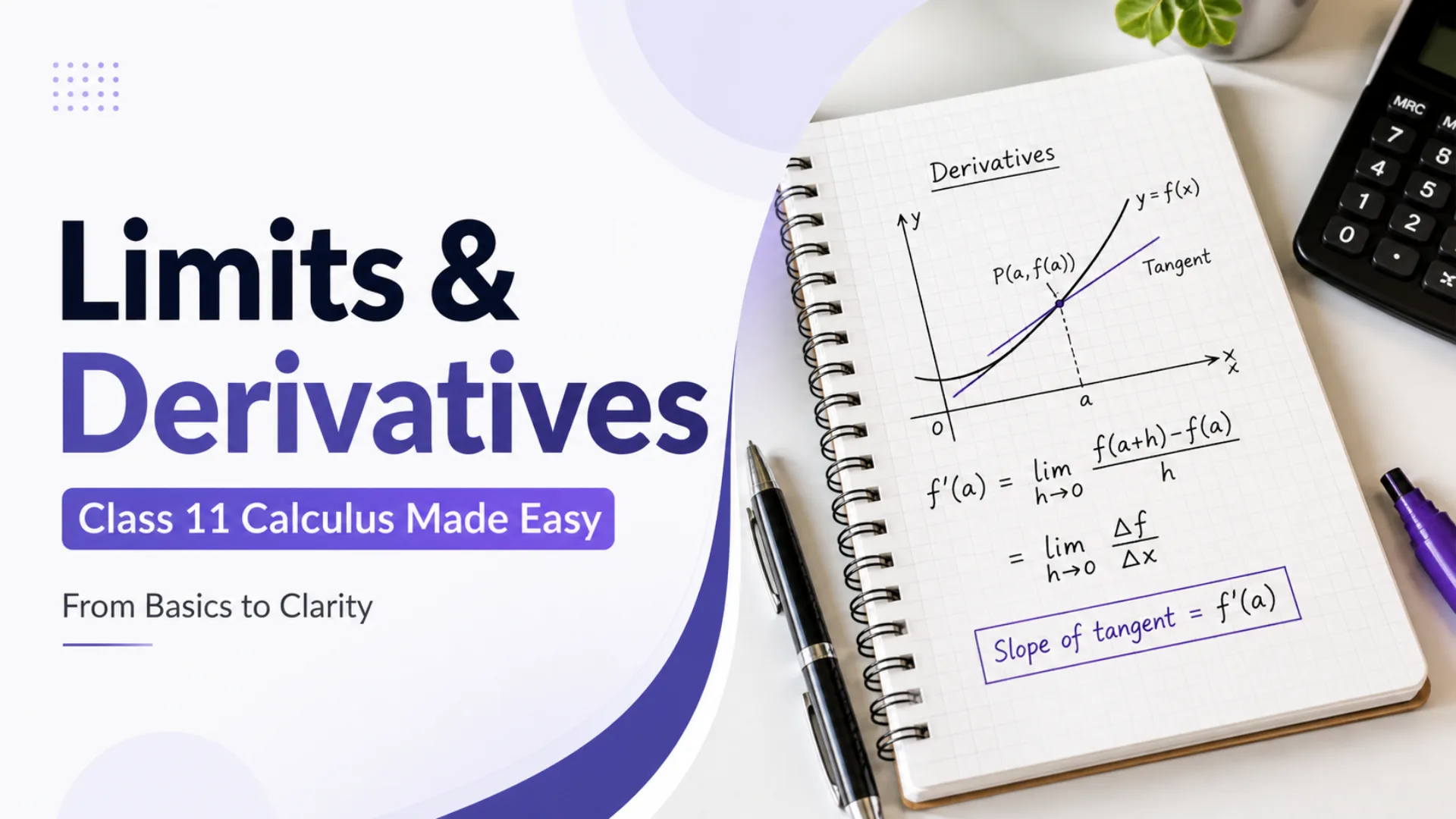
After mastering limits, the next step in calculus is the derivative. A derivative measures the rate at which a function's value changes as its input changes. The derivative of a function f(x) at a point x is defined as: f'(x) = lim(h->0) [f(x + h) - f(x)] / h.
The Power Rule and Other Derivative Rules
- Power Rule: d/dx (x^n) = n x^(n-1)
- Constant Multiple Rule: d/dx [c f(x)] = c f'(x)
- Sum Rule: d/dx [f(x) + g(x)] = f'(x) + g'(x)
- Product Rule: d/dx [f(x) g(x)] = f'(x) g(x) + f(x) g'(x)
- Quotient Rule: d/dx [f(x)/g(x)] = [f'(x) g(x) - f(x) g'(x)] / [g(x)]^2
Derivatives of Trigonometric Functions
- d/dx (sin x) = cos x
- d/dx (cos x) = -sin x
- d/dx (tan x) = sec^2 x
- d/dx (cot x) = -cosec^2 x
- d/dx (sec x) = sec x tan x
- d/dx (cosec x) = -cosec x cot x