
Master Linear Equations in Class 8 | Claps Learn
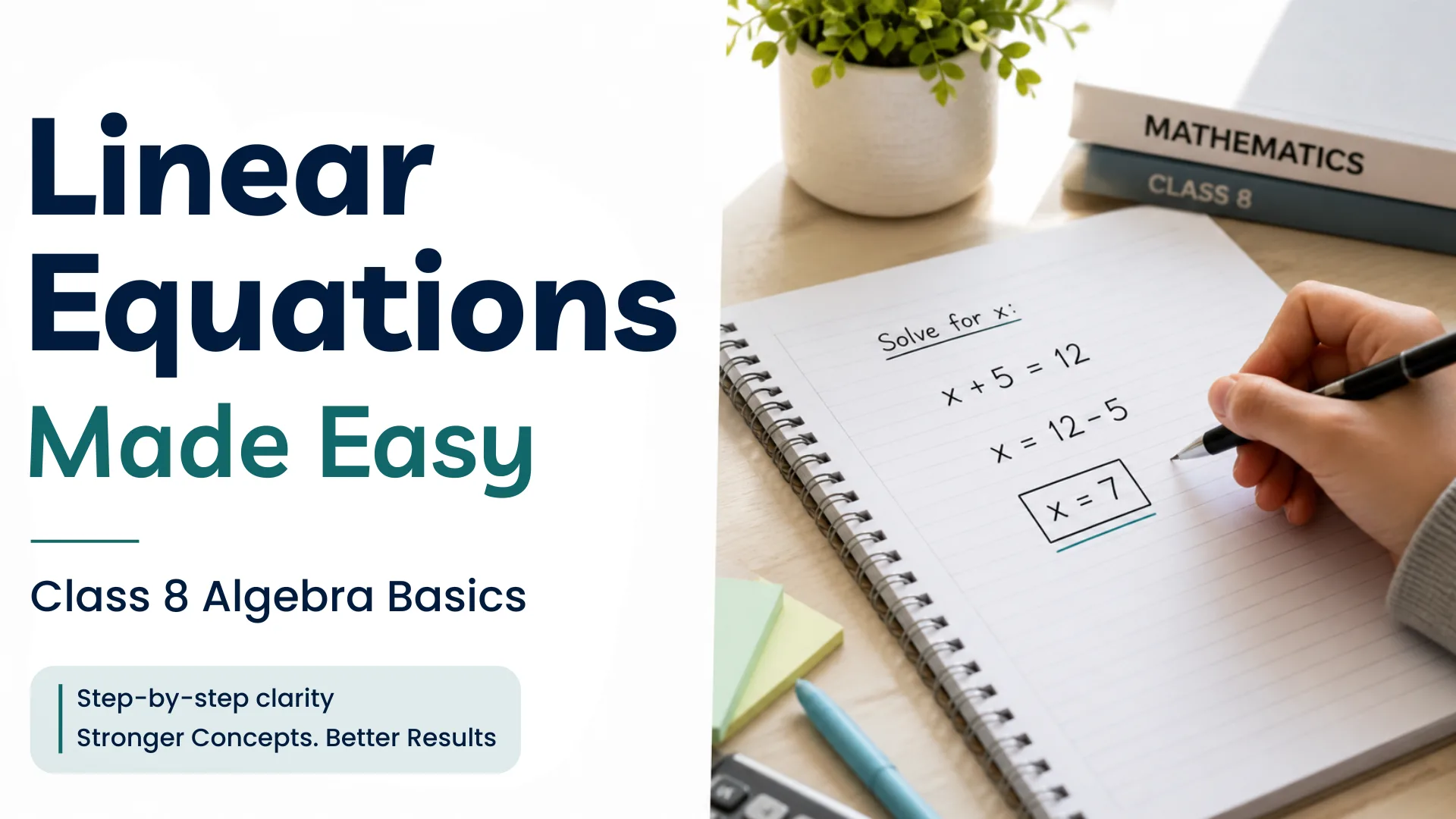
Linear equations in one variable are the foundation for Class 9 graphs, Class 10 quadratic equations, and Class 11 algebra. Master this topic well, and every math class that follows becomes easier.
Why Linear Equations Are the Most Important Topic in Class 8 Mathematics
If there is one topic in Class 8 Maths that connects to nearly everything you will study in higher grades, it is linear equations. Class 8 linear equations in one variable are not just a chapter in your textbook. They are the foundation for Class 9 graphs, Class 10 quadratic equations, and Class 11 algebra.
The good news: linear equations are one of the most straightforward topics in algebra once you understand the logic. There are no complicated formulas to derive. There is one core skill to learn: keep the equation balanced.
What Is a Linear Equation in One Variable?
A linear equation in one variable is any equation that: Has only one variable (usually x), The variable is raised to the power of 1 (not squared or cubed), Can be written in the form ax + b = c, where a, b, and c are constants.
The Golden Rule: Keep the Equation Balanced
Every operation you do on one side of the equation, you must do on the other side. Think of an equation as a weighing scale in perfect balance. Whatever you remove from one side, you must remove from the other.
Step-by-Step: Solving 2x + 5 = 13
- Identify the goal: We want to isolate x on one side of the equation.
- Remove the constant term from the left side: 2x + 5 - 5 = 13 - 5, so 2x = 8
- Remove the coefficient: Divide both sides by 2, so x = 4
- Verify: Substitute x = 4 back into the original equation: 2(4) + 5 = 13, 8 + 5 = 13. Correct.
Common Mistakes to Avoid
- Changing signs when moving terms across the equals sign
- Forgetting to multiply or divide the entire equation
- Solving in the wrong order
Word Problems: Turning a Story Into an Equation
Word problems are where most Class 8 students lose marks, not because they cannot solve equations, but because they cannot set them up correctly. General rule: identify what you need to find, assign it a variable, and express every other quantity in the problem in terms of that variable.