
Why Your Child's Report Card Does Not Tell the Full Story
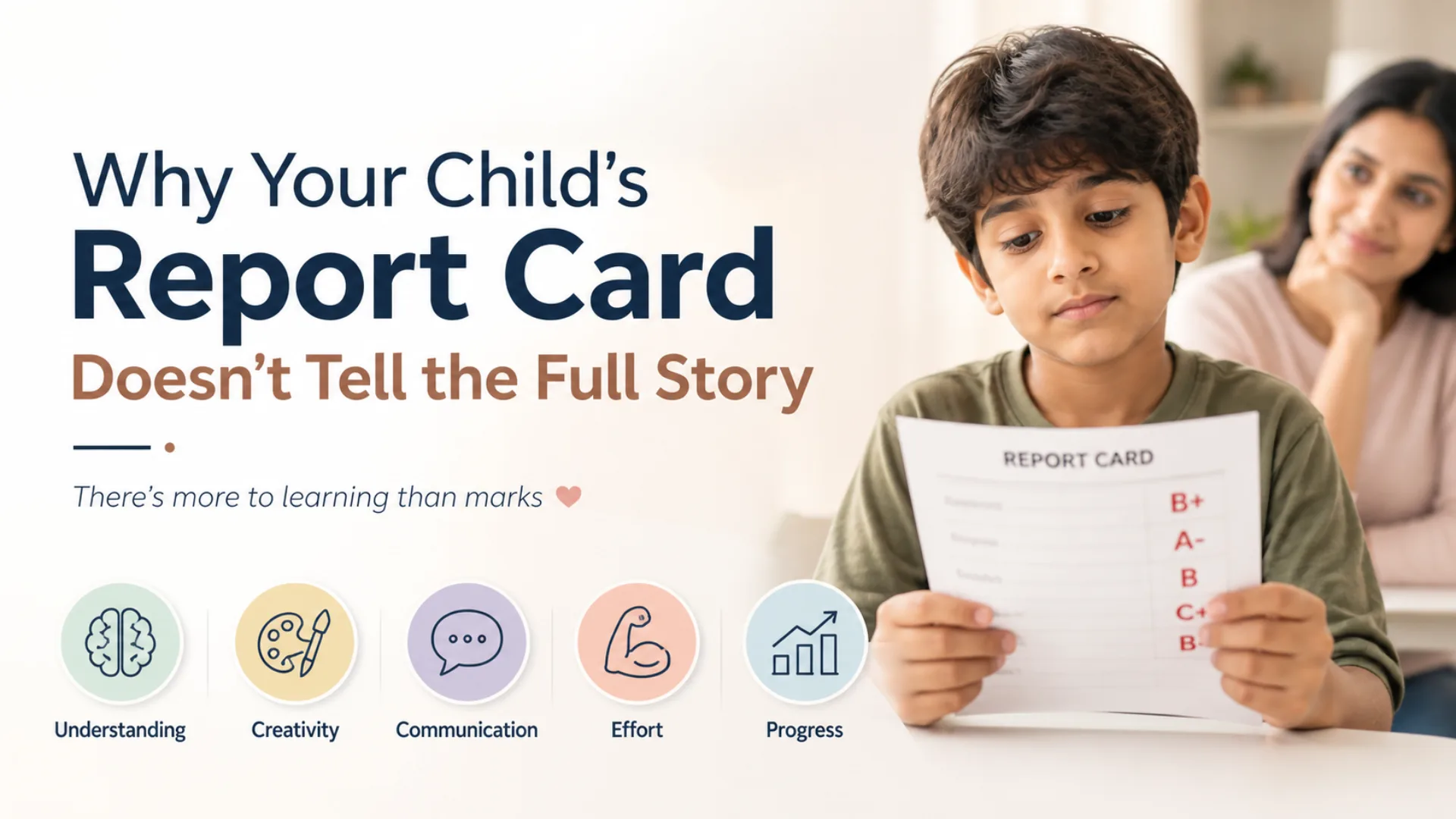
Your child brings home a report card with B-minus in Mathematics and a comment that reads "Could work harder." Your instinct is to worry and enroll them in extra tutoring. But what if that B-minus obscures a fundamental transformation in how your child approaches problems? What if the comment comes from a teacher who has not seen your child stay up late explaining concepts to a younger sibling? Report cards are structured for standardization, not nuance. They compress months of learning into a few letters and phrases that rarely capture the full picture.
What a Report Card Measures and What It Does Not
What grades do measure: Performance on standardized assessments, completion and submission of assigned work, behavior and participation in class, certain measurable skills.
What grades systematically miss: Creative thinking that does not fit expected answer format, conceptual understanding versus rote memorization, persistence and growth mindset, social skills and collaboration, metacognitive awareness.
A student can memorize a formula and apply it correctly on a test to earn an A, while a peer who truly understands the underlying concept but makes minor errors earns a B.
The Grades-Context Mismatch
A single letter grade means very different things depending on the classroom environment, teacher expectations, and the student's starting point.
Grades often reflect compliance as much as competence. A student who hands in everything on time often earns higher grades than one who produces more insightful work but is disorganized.
The Hidden Dimensions Your Report Card Cannot Capture
- Critical thinking and problem-solving under uncertainty
- Learning how to learn — which study techniques work for them
- Academic resilience — how does your child respond when something is difficult?
- Love of learning itself — curiosity that no report card can capture
How to Get a More Complete Picture
- Ask specific questions to the teacher beyond the grade
- Review actual work samples, not just grades
- Observe your child in non-academic contexts where learning shows up
- Use standardized assessments sparingly as one data point among many
- Consider a 1-on-1 assessment with a tutor
FAQ: Report Cards
Should I ignore report cards entirely?
No. Report cards are one data point among many and should not be ignored. Use them as a starting point for conversation rather than a final verdict.
My child is getting straight A's but seems to hate learning. Should I be concerned?
Yes. Grades without intrinsic motivation are a fragile achievement. Foster curiosity and allow exploration of passions.
Can a tutor help if my child has a good report card but I sense something is off?
Yes. Tutors often catch conceptual gaps that do not show up in grades because the curriculum moves too fast for gaps to accumulate.