
Kerala SSLC 2027 Time Table: Exam Dates and a Month-by-Month Study Plan
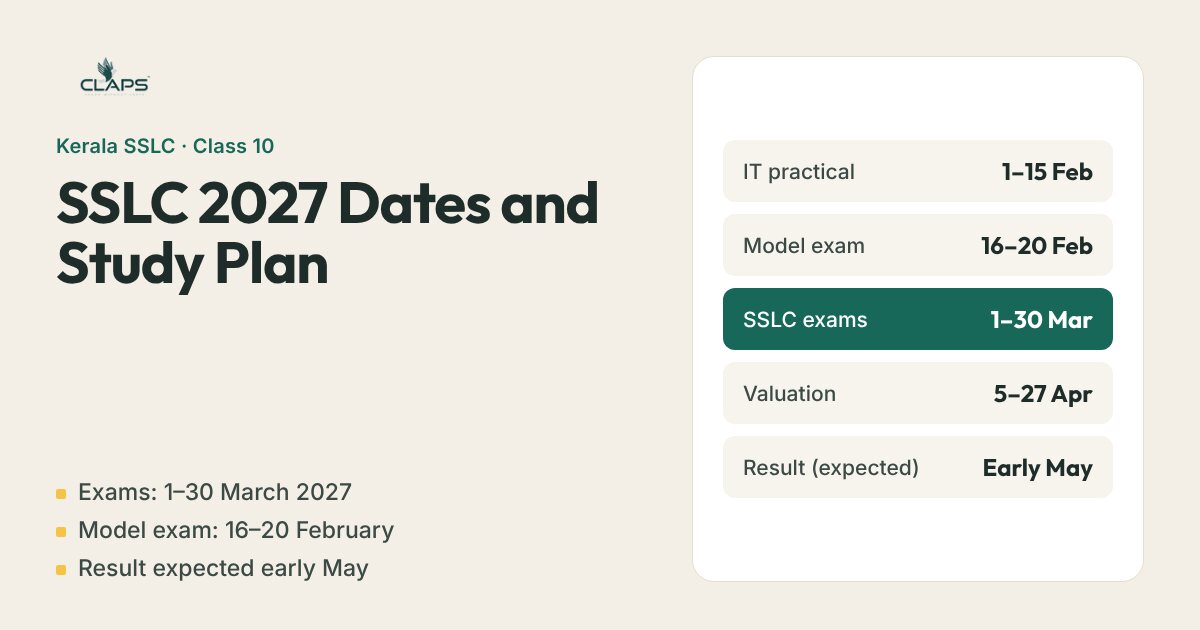
The Kerala SSLC exams for 2026-27 will be held from 1 to 30 March 2027. General Education Minister N Samsudheen announced the dates on 13 November 2026, together with the IT practical, the model exam and the valuation schedule. About 4.25 lakh students will write at 3,049 centres, including centres in the Gulf and Lakshadweep.
Kerala SSLC 2027: the confirmed dates
- SSLC, THSLC, AHSLC and hearing-impaired streams: 1 to 30 March 2027.
- Paper timing: 9.30 am, except the paper on 8 March, which starts at 2 pm.
- IT practical exam: 1 to 15 February 2027.
- SSLC model exam: 16 to 20 February 2027.
- Valuation: 5 to 27 April 2027.
- Result: expected in the first week of May 2027 (not a fixed date).
Candidate registration opened on 18 November 2026 through schools on the new Unified Examination Management System. Check with your school that your child's name, date of birth and subjects are entered correctly; mistakes are far harder to fix after the hall ticket is printed.
Is the subject-wise timetable out?
Not officially, as of 21 November 2026. Some websites already show a subject-by-subject list, but it has no Chemistry paper and has not appeared on Pareeksha Bhavan's site, so do not plan around it yet. The official timetable will be published by the Commissioner for Government Examinations on pareekshabhavan.kerala.gov.in and sslcexam.kerala.gov.in. We will update this page when it is.
For a feel of the spacing, the 2026 exam ran from 5 to 30 March 2026 in this order: First Language Part I, English, First Language Part II, Hindi, Mathematics, Physics, Social Science, Chemistry and Biology. The 2027 order may differ.
Pass rules for SSLC 2027
The plan to require at least 30% in the written exam of every subject (with continuous evaluation marks not counting towards it) has been put on hold for SSLC this academic year. The usual rule applies in March 2027: a student needs at least a D+ grade (30%) in every subject, counting the written exam and continuous evaluation together, to be eligible for higher studies.
A month-by-month study plan
Late November and December: finish and fix
- Finish any chapter not yet taught, using the textbook first and guides second.
- Treat the Christmas exam (8 to 17 December 2026) as a full rehearsal; see the Christmas exam timetable.
- Make one notebook page per chapter with the formulas, definitions, diagrams and map points you keep forgetting.
January: past papers and weak chapters
- Collect the corrected Christmas papers and list every mark lost and why: concept, calculation, presentation or time.
- Write one full previous-year SSLC paper per core subject under timed conditions.
- Spend twice as long on Mathematics, Physics and Chemistry chapters marked weak as on chapters you already know.
February: practical and model exams
- 1 to 15 February: the IT practical. Practise the listed activities on a computer, not just on paper.
- 16 to 20 February: the model exam. Write it seriously; it is the closest thing to the March papers.
- After the model exam, redo every question you got wrong within three days, while the mistake is still fresh.
March: revise, sleep, repeat
- No new chapters. Revise from your one-page notes and your list of mistakes.
- Use the gaps between papers for the next subject only; do not go back over papers already written.
- Reach the centre early: papers start at 9.30 am except on 8 March (2 pm).
Where Mathematics marks are lost
In SSLC Mathematics, marks are commonly lost through skipped steps, unlabelled diagrams in constructions and arithmetic slips in long problems. Write every step, label every construction and keep five minutes at the end to recheck calculations. If your child needs one-to-one help in a single subject, our Kerala SSLC Maths tuition page explains how a tutor works with the SCERT textbook.