
ICSE Class 9 Physics: Understanding Motion and Force
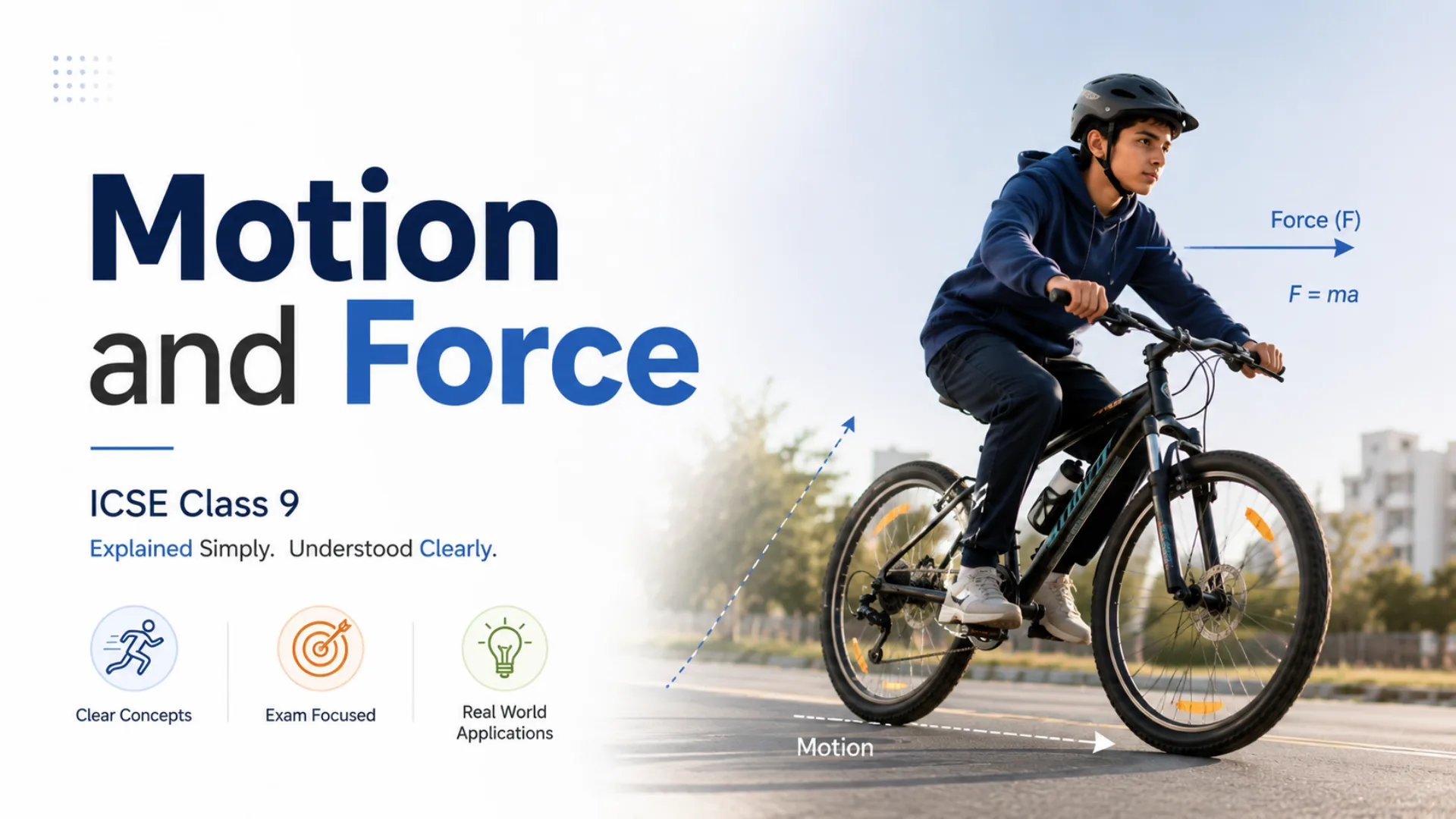
When you first open your ICSE Class 9 Physics textbook and see "Motion and Force" as the opening chapter, you might wonder why Physics feels so different from anything you have studied before. Unlike Mathematics, which deals with abstract numbers, or History, which tells stories of the past, Physics explains why the world moves the way it does. Yet, for many Class 9 students, Motion and Force becomes the chapter where confusion sets in. Terms like distance versus displacement, speed versus velocity, and the mysteriously invisible "force" feel overwhelming at first. This guide exists because we at ClapsLearn have helped thousands of ICSE students overcome that initial hurdle. What follows is our distilled approach to understanding Motion and Force, explained the way a patient 1-on-1 tutor would explain it in your first free demo class.
What is Motion? Understanding Distance, Displacement, Speed, and Velocity
The Foundation: When Does Motion Happen?
Motion occurs when an object changes its position over time relative to a reference point. Think of it this way: your school bus is moving when it passes your house but appears stationary to another passenger sitting next to you.
Distance vs. Displacement
Distance is the total path length covered by an object, regardless of direction. Displacement is the shortest straight-line path between where you started and where you ended up.
Imagine walking 3 meters east, then 4 meters north, then 3 meters west, and finally 4 meters south to return to your starting point. Your distance traveled is 14 meters. Your displacement is 0 meters because you ended up exactly where you started.
Speed vs. Velocity
Speed is how fast something is moving without regard to direction. Velocity includes direction. Average speed equals total distance divided by total time. Average velocity equals total displacement divided by total time.
If you drive 100 kilometers north in 2 hours, your average speed is 50 km/h. If you then drive 100 kilometers south in 2 hours, your total distance is 200 kilometers, so average speed is 200 km divided by 4 hours, which equals 50 km/h. However, your average velocity for the entire trip is 0 km/h because your net displacement is zero.
The Formulas You Need to Remember
- Speed = Distance / Time
- Velocity = Displacement / Time
- Both speed and velocity are measured in meters per second (m/s) in SI units
The Three Laws of Motion Explained Simply (With Real-World Examples)
Newton's First Law: The Law of Inertia
An object remains at rest or continues moving in a straight line unless acted upon by an external force.
This law introduces the concept of inertia, which is essentially an object's resistance to changing its state of motion. A book sitting on your desk stays there until someone moves it.
Real-world example: When a car suddenly brakes, passengers lurch forward. Their bodies wanted to continue moving at the car's original speed (inertia of motion). Wearing a seatbelt counteracts this by providing the external force needed to stop your body along with the car.
Newton's Second Law: Force Equals Mass Times Acceleration
The force acting on an object equals its mass multiplied by its acceleration. In equation form: F = ma.
This is probably the most frequently used formula in ICSE Class 9 Motion and Force problems. It tells us that heavier objects require more force to achieve the same acceleration as lighter objects.
Newton's Third Law: Action and Reaction
For every action, there is an equal and opposite reaction.
This means forces always occur in pairs. When you push against a wall, the wall pushes back against you with equal force. When you walk, your foot pushes backward against the ground, and the ground pushes you forward.
Numerical Problems in Motion and Force: A Step-by-Step Approach
- Identify Given Quantities: Read the problem twice before doing anything else. List everything that is given. Convert all quantities to SI units.
- Identify What the Problem is Asking: Are they asking for speed, velocity, acceleration, force, or something else? Underline the question.
- Select the Right Formula: Based on what you identified, choose the appropriate formula.
- Substitute Carefully and Calculate: Double-check your arithmetic.
- Include Units in Your Answer: Write m/s, kg, N, or m as appropriate.
Worked Example
A car of mass 1000 kg accelerates from rest to 20 m/s in 10 seconds. Calculate the force exerted.
Given: m = 1000 kg, u = 0 m/s, v = 20 m/s, t = 10 s. Find: Force (F).
First find acceleration: a = (v - u) / t = (20 - 0) / 10 = 2 m/s². Then find force: F = m × a = 1000 × 2 = 2000 N.
The force exerted is 2000 Newtons.
Common Misconceptions About Force and Motion (And How to Avoid Them)
Misconception 1: "Force is needed to keep objects moving"
Many students believe that without a continuous force, objects stop moving. In reality, according to Newton's First Law, objects continue moving in the absence of external forces. The reason most objects in daily life eventually stop is because of external factors like friction and air resistance.
Misconception 2: "Heavier objects fall faster"
This misconception dates back to Aristotle. Galileo's experiments proved this wrong. In the absence of air resistance, all objects fall at the same rate (approximately 9.8 m/s² on Earth).
Misconception 3: "Velocity and speed are the same thing"
Speed is a scalar quantity (magnitude only). Velocity is a vector quantity (magnitude and direction). An object can have constant speed but changing velocity (like uniform circular motion, where direction constantly changes).
Misconception 4: "Action and reaction forces cancel out"
Newton's Third Law pairs are equal and opposite, but they act on different objects, so they never cancel each other out. The force you exert on the ground and the ground's force on you are an action-reaction pair, but they act on different bodies.
How to Practice Motion and Force Problems Effectively for ICSE Class 9
- Build a Formula Sheet: Create a single-page reference sheet with all formulas from this chapter.
- Solve One Problem Set Daily: Dedicate 20-30 minutes daily to solving Motion and Force problems.
- Practice Vector Direction Problems Intentionally: Since vector direction trips many students up, specifically seek problems involving direction changes.
- Review Your Mistakes Immediately: When you solve a problem incorrectly, identify exactly where your reasoning went wrong.
- Connect Physics to Daily Life: Look for Motion and Force examples throughout your day.
- Use Past ICSE Papers: Obtain past five years of Motion and Force questions from ICSE Physics papers.
Frequently Asked Questions (FAQs)
1. What is the difference between distance and displacement in simple terms?
Distance is the total path length you travel, no matter which direction you go. Displacement is the shortest straight-line distance between your starting point and ending point, including direction.
2. How do I remember the three laws of motion easily?
Associate each law with a real-life situation. First Law (Inertia): A book stays on your desk until you move it. Second Law (F = ma): Pushing an empty shopping cart is easier than a full one. Third Law (Action-Reaction): Jumping off a boat pushes the boat backward as you move forward.
3. What is the unit of force in SI?
The SI unit of force is the Newton (N). One Newton is the force required to accelerate a mass of 1 kilogram at 1 meter per second squared.
4. Why does a moving car stop when the engine is turned off?
The engine is not what keeps the car moving; it is simply the source of force that overcomes opposing forces. Once the engine stops providing forward force, friction between the tires and road and air resistance gradually slow the car down.
5. Can an object have high speed but low velocity?
Speed and velocity are the same magnitude when motion is in a constant direction. However, in circular motion, an object can have constant speed but continuously changing velocity because the direction changes.
6. How is acceleration different from velocity?
Velocity describes how fast an object is moving and in which direction. Acceleration describes how quickly velocity changes.
7. What is the relationship between mass and inertia?
Mass is a measure of inertia, which is an object's resistance to changes in its state of motion. Greater mass means greater inertia.
8. How do I approach numerical problems in ICSE Physics Motion and Force exam?
Follow the five-step approach: identify given quantities, identify what is being asked, select the correct formula, substitute and calculate, and include units in your answer.
Conclusion
Motion and Force is the foundation upon which the rest of your ICSE Class 9 Physics course builds. These are not abstract concepts meant only for examinations; they are the rules that govern every physical interaction you experience daily. Understanding them deeply will serve you not only in this chapter but throughout your entire Physics journey.