
IB Math AI vs AA: A Complete Comparison for Class 11 Students
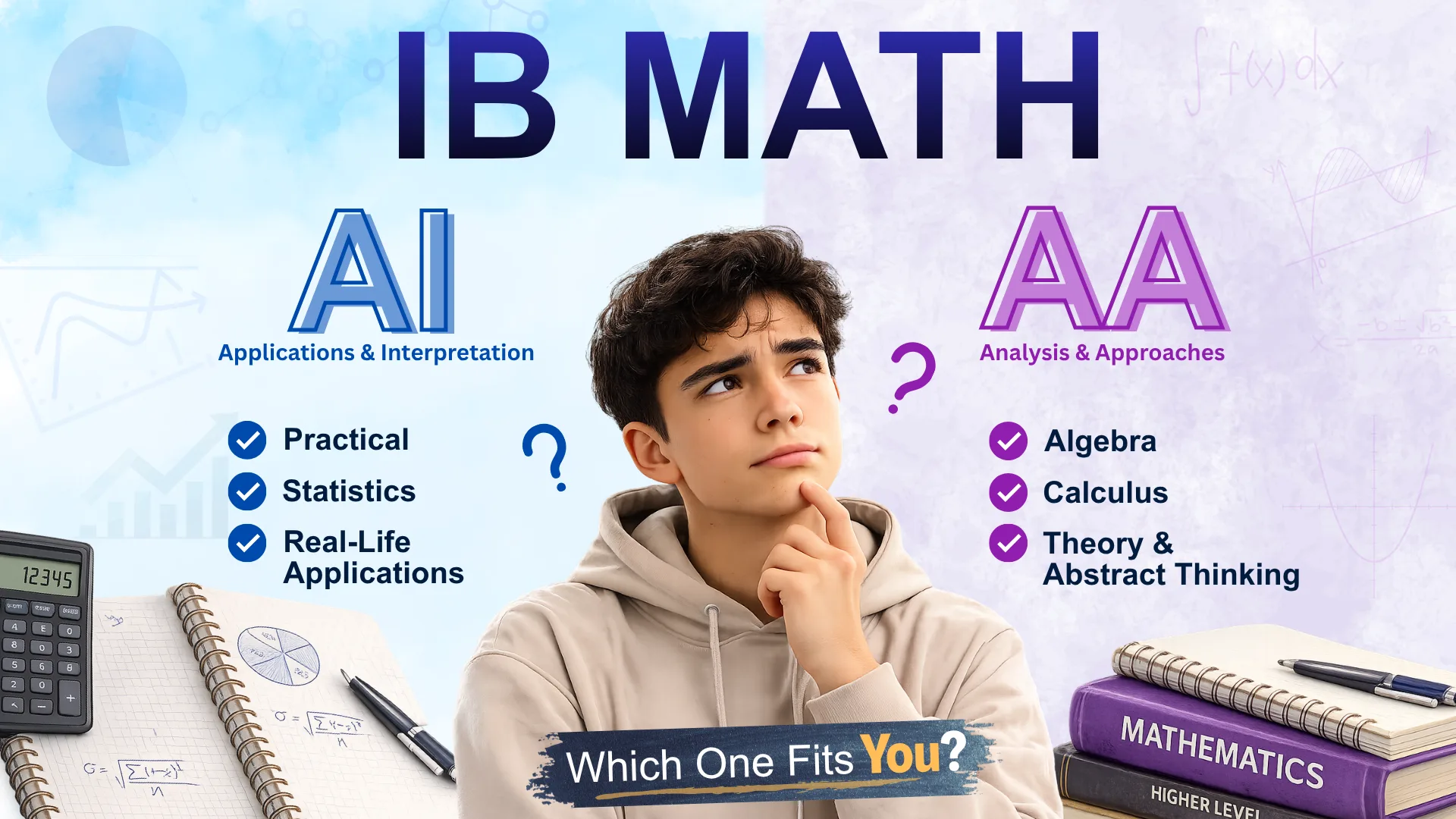
Standing at the crossroads of Class 11, you face a decision that will ripple through your IB Diploma journey and echo into your university applications: which IB Mathematics course should you take? The choice between Mathematics: Analysis and Approaches (AA) and Mathematics: Applications and Interpretation (AI) is not merely a administrative checkbox. It shapes the nature of your daily coursework, influences which university programmes remain accessible to you, and signals to admissions committees where your mathematical strengths lie. This guide cuts through that confusion. We have compiled a comprehensive, side-by-side comparison of IB Math AA and AI, drawing on current university requirements from the UK, US, and India, as well as practical insights from our years of IB tutoring experience.
What is IB Math Analysis & Approaches (AA)?
Mathematics: Analysis and Approaches (AA) is the IB Mathematics course designed for students who enjoy mathematical reasoning, theoretical understanding, and the elegance of formal mathematical proof. If you find satisfaction in deriving solutions from first principles, exploring the "why" behind mathematical formulas, and working through abstract problem sets, AA is likely your natural fit.
AA places a strong emphasis on calculus, algebra, and mathematical proofs. The course develops your ability to construct logical arguments, manipulate symbolic expressions, and understand mathematics as a coherent discipline rather than a collection of formulas to memorize.
Universities view AA as the more traditional and theoretically rigorous Mathematics course. For programmes where mathematical theory is paramount, AA HL signals strong analytical thinking and quantitative reasoning skills.
What is IB Math Applications & Interpretation (AI)?
Mathematics: Applications and Interpretation (AI) is the IB Mathematics course built for students who prefer using mathematics as a practical tool to model and solve real-world problems. If you are more interested in applying statistical techniques, interpreting data sets, and using technology to analyse patterns than in deriving equations from scratch, AI may be the better pathway.
AI emphasises statistics, modelling, probability, and the use of technology (particularly graphing calculators and spreadsheet software) to handle complex calculations.
Universities recognise AI as a course that develops practical quantitative skills, data literacy, and the ability to apply mathematical concepts to complex, messy real-world scenarios.
IB Math AA vs AI: Key Differences at a Glance
- Primary Focus: AA is mathematical theory, proof, and rigorous reasoning. AI is practical application, modelling, and data interpretation.
- Core Topics: AA covers calculus, algebra, proofs, complex numbers. AI covers statistics, probability, modelling, differential equations.
- Calculator Reliance: AA is moderate with emphasis on analytical solutions. AI is high with technology integrated throughout.
- Assessment Style: AA uses longer written solutions and proof-based responses. AI uses data analysis tasks, modelling projects, technology-assisted work.
- Typical Student Profile: AA suits future mathematicians, physicists, engineers, theoretical scientists. AI suits economists, social scientists, data analysts, business students.
Which Should You Choose? AA vs AI Based on Your University Goals
For Engineering, Physics, and Mathematics Degrees
If you are targeting engineering programmes at top universities, HL Mathematics AA is the standard expectation. UK universities, particularly Imperial College London, University of Cambridge, and Oxford, explicitly require HL Mathematics AA for engineering admissions.
Indian students targeting IIT through JEE or studying abroad through international admissions should note that HL Mathematics AA provides the strongest foundation for engineering mathematics coursework.
For Economics, Finance, and Business Degrees
Economics programmes at UK universities vary in their Mathematics requirements. Many economics programmes prefer HL Mathematics AA due to the mathematical economics components. However, an increasing number of economics departments recognise HL Mathematics AI as adequate.
For Social Sciences, Humanities, and Arts Degrees
If your university aspirations centre on social sciences, humanities, or the arts, you may find SL Mathematics sufficient. Many programmes in these fields do not specify a particular Mathematics level.
For Computer Science and Data Science
Computer science programmes have mixed Mathematics expectations. UK universities like Oxford and Cambridge typically require HL Mathematics AA for computer science admissions.
Tips for Succeeding in Your IB Math Choice
- Understand Your Course's Assessment Weightings: Both AA and AI assessments include external examinations (80% at SL and HL) and an internal assessment (Exploration).
- Build a Strong Foundation Before Class 11 Starts: Revise algebra, functions, and basic calculus concepts thoroughly.
- Master the Use of Technology: For AI especially, technology is not optional but integral. Learn to use your graphic display calculator (GDC) proficiently from day one.
- Develop Strong Notation Habits: IB Math grading penalises poor mathematical communication.
- Start Your Exploration Early: The IB Math Exploration constitutes 20% of your final grade and offers an opportunity to explore a mathematical topic of personal interest.
Frequently Asked Questions (FAQs)
1. Can I switch from AI to AA (or vice versa) after starting Class 11?
Switching between AI and AA is possible but not straightforward. Both courses have different content coverage in the first year. It is generally easier to switch from AA to AI than the reverse.
2. Do universities prefer AA over AI for engineering programmes?
Yes, for most UK engineering programmes at competitive universities, HL Mathematics AA is preferred or required. Imperial College London, Cambridge, and Oxford specify AA HL for engineering admissions.
3. Is HL Mathematics required for medicine or law?
No, HL Mathematics is not typically required for medicine or law. Medical schools focus on HL Chemistry and HL Biology. Law programmes rarely specify Mathematics requirements.
4. Which is harder: IB Math AI HL or AA HL?
Difficulty depends on your aptitude and learning style. AA HL is harder for students who struggle with abstract theory and proof construction. AI HL is harder for students who find statistical reasoning challenging.
5. Can I take SL Mathematics if I am targeting a science programme?
For many science programmes, particularly in the UK, SL Mathematics is insufficient if you are targeting a science degree. UK universities often require HL Mathematics for biology, chemistry, and physics programmes.
6. Does AI HL cover calculus?
Yes, AI HL includes differential equations and applications of calculus, though with less theoretical depth than AA HL. AI calculus focuses on practical applications rather than pure mathematical theory.
7. How does the IB Math Exploration differ between AA and AI?
The Exploration for both courses is a 12-20 page mathematical investigation worth 20% of your final grade. AA Explorations typically involve mathematical proof or analytical investigation. AI Explorations typically involve statistical analysis of real data or mathematical modelling.
8. Do Indian universities accept IB Math AI for engineering admissions?
Indian universities that admit students through international board pathways generally accept both AI and AA. However, for programmes with strict mathematics requirements, AA is the safer choice.