
CBSE Competency-Based Questions for Class 10: What They Are, Examples and How to Prepare
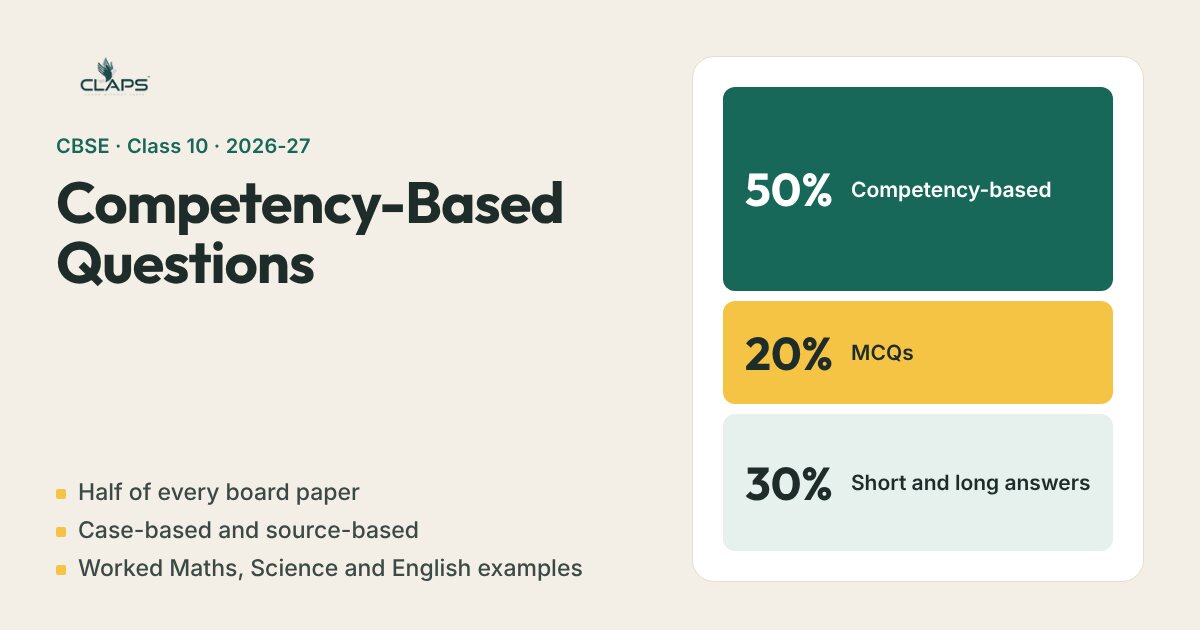
Since 2023-24, half the marks in a CBSE Class 10 board paper come from competency-based questions. They test whether a student can use a concept in an unfamiliar situation, not just repeat it. Check the 2026-27 sample paper for each subject on CBSE's academic website to see exactly how the split applies before the February 2027 board exams.
How a Class 10 paper is split
- Competency-focused questions: 50% of the marks. These can be multiple-choice, case-based, source-based or integrated questions.
- Selected-response questions (MCQs): 20%.
- Short and long answer questions: 30%.
Class 12 papers moved to the same 50% competency share from 2024-25. Practising from CBSE's own sample papers for 2026-27 is the safest preparation, because they show the current pattern subject by subject.
What makes a question competency-based
A recall question asks you to state a fact or a formula. A competency-based question gives you a situation you have not seen before (a graph, a paragraph, a table, a real-life problem) and asks you to choose and apply the right idea. The concept is from the textbook; the setting is new.
Worked example: Mathematics
Case: a school is fencing a rectangular garden 24 m long and 18 m wide, and wants to plant saplings at equal gaps along the fence, with one sapling at every corner and the largest possible gap.
- What is the largest possible gap? The gap must divide both 24 and 18 exactly, so it is their HCF: 6 m.
- How many saplings are needed? The perimeter is 2 × (24 + 18) = 84 m, and 84 ÷ 6 = 14 saplings.
- If the gap had to be 4 m, could there still be a sapling at every corner? No: 4 divides 24 but not 18.
The chapter is Real Numbers (HCF), but the question never says "find the HCF". Recognising that is the competency being tested.
Worked example: Science
Case: a student places a candle 30 cm in front of a convex lens of focal length 15 cm and finds a sharp image on a screen.
- Where is the screen? Using 1/v − 1/u = 1/f with u = −30 cm and f = +15 cm: 1/v = 1/15 − 1/30 = 1/30, so v = +30 cm, on the other side of the lens.
- Is the image enlarged? Magnification m = v/u = 30/(−30) = −1, so the image is real, inverted and the same size as the candle.
- Where should the candle go for an enlarged real image? Between f and 2f, that is between 15 cm and 30 cm from the lens.
Worked example: English reading
A source-based question gives a short unseen passage, for example a notice about a water-saving drive, and asks what the writer's purpose is, what a phrase means in context, or which statement the passage supports. The skill is reading closely and choosing the answer the text actually supports, not the one that sounds right.
A weekly practice routine
- Pick one chapter a day and do five competency-based questions on it after finishing the textbook exercises.
- Before answering, underline the data in the case and write which concept it calls for.
- Write the formula or rule first, then substitute. Method marks are given even if the final answer slips.
- Once a week, do the competency section of a CBSE sample paper under timed conditions.
- Keep a list of the questions you could not start. Those show the concepts you know by heart but cannot yet apply.
Where to find official practice questions
- CBSE sample question papers and marking schemes for 2026-27, on cbseacademic.nic.in.
- CBSE's Competency Based Education section, with Science, Mathematics and English reading items for Classes 6 to 10.
- CBSE's Competency Focused Practice Questions booklets, for example for Class 10 Mathematics.
For the board timetable and how the optional second exam works, see CBSE Class 10 board exams 2027: how the two exams work and the Class 10 board study plan for 2027.