
Cambridge International AS Level Results Guide | What Parents Need to Know
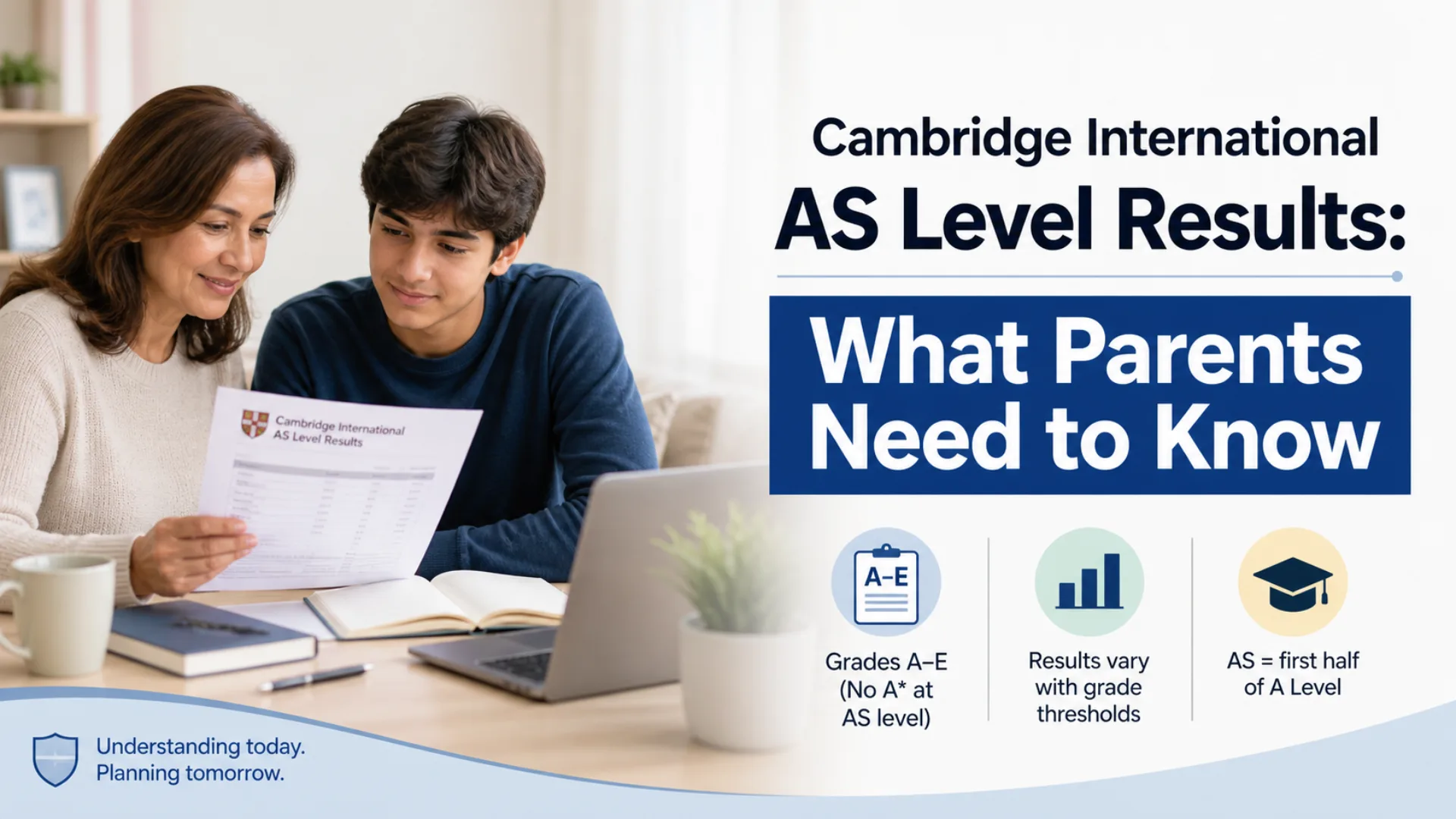
The moment your child's Cambridge International AS Level results arrive, emotions run high. A grade that meets the offer condition feels like a door opening. A grade that falls short can feel like the opposite. As a parent, you may find yourself staring at a combination of letters and numbers — A*, A, B, C, D, E — without knowing exactly what each grade means for your child's future, or what options are available if things didn't go as planned. This guide walks you through everything Cambridge International AS Level results mean, how universities interpret them, what to do if your child is disappointed, and how to plan the next academic steps with clarity and confidence.
What Are Cambridge International AS Levels?
AS Level (Advanced Subsidiary Level) is a part of the Cambridge International A Level qualification. It represents the first half of a full A Level programme and is typically taken after IGCSE or equivalent secondary school qualifications.
Students can take AS Levels as: • A standalone qualification (useful for bridging or early university applications) • Part of a full A Level (AS in Year 1, A2 in Year 2)
AS Level exams are held twice a year — in June and November. Results are released by Cambridge International several weeks after the exam period, typically in August (for June session) and January (for November session).
Understanding AS Level Grades
Cambridge AS Levels use a letter grading scale from A* to E. Here's how universities and institutions generally interpret them:
Each grade reflects a combination of raw marks, grade boundaries (which vary by subject and session), and statistical moderation to ensure consistent standards across years.
How Universities Use AS Level Results
Whether your child is applying to universities in the UK, Canada, Australia, India, or elsewhere, AS Level results play a significant role in admissions decisions.
In the UK:
Universities use AS Level results as part of conditional offers, especially for competitive courses like Medicine, Engineering, or Law. A strong AS performance in relevant subjects can unlock offers from top universities.
In the US:
AS Levels are recognized for college credit at many institutions. Some universities grant advanced standing or credit for high-scoring AS papers, particularly in subjects like Mathematics, Physics, or languages.
In India:
AS/A Level results are accepted for admission to several universities and are particularly relevant for students applying abroad or to institutions accepting international qualifications through CUET or direct applications.
For Indian university admissions: Institutions like Ashoka University, MIT-WPU, and other private universities recognize A Levels and AS Levels for admission. The AIU provides equivalence guidance.
What to Do If Your Child's Results Don't Meet Offer Conditions
This is one of the most stressful scenarios for parents — and it happens more often than people think. Here's a step-by-step guide.
1. Don't panic. Assess your options.
Missing an offer condition doesn't mean the university door is closed. Some universities are flexible, especially if the shortfall is marginal.
2. Contact the university directly.
Many UK universities have a "clearing" or "adjustment" process. Some may accept a slightly lower grade if there are compelling circumstances.
3. Consider a remark or clerical check.
If you believe the grade does not reflect your child's actual performance — especially if there was a marking error — Cambridge International allows remark requests. This costs a fee but can result in a grade change.
4. Explore retake options.
AS Level exams can be retaken in the next session (November or June, depending on subject availability). This is a valid path if your child needs to improve grades for a specific university course.
5. Look at alternative university pathways.
If your child's original choice is no longer viable, use this time to research universities with flexible entry requirements. Many excellent institutions don't require top grades — they look at the overall profile.
The Remark Process — How It Works
Cambridge International offers several post-result services:
- Clerical re-check: Verifies that all components were marked and the total is correct. Low chance of grade change.
- Review of marking: A senior examiner reviews the marking to ensure it meets the standard. Higher chance of change but costs more.
- Access to scripts: Allows you to request copies of your child's marked exam papers to understand where marks were lost.
Timeline: Remark requests must be submitted through your child's school or Cambridge International authorized center within a specific window (typically 21 days of result release). As a parent, you'll need to coordinate with the school.
Cost: Fees vary by subject and service type. Clerical checks are typically around GBP 20-30 per paper; full reviews are higher.
AS Level Retakes — What Parents Should Know
If a retake is the chosen path, here is what to plan for:
Subject availability:
Not all Cambridge AS subjects are available in both June and November sessions. Check the Cambridge International subject availability calendar.
Study plan:
A retake gap typically spans 3-6 months. Your child will need a structured revision plan. This is where 1-on-1 tutoring can make a significant difference — personalized coaching targeted at the specific topics and paper techniques where marks were lost.
University conditional offers:
If your child has received a conditional offer for university that AS results impact, check whether the university will accept the retake grade to fulfill the condition. Most UK universities do.
Costs:
Cambridge exam entry fees apply per subject per session, ranging from approximately INR 5,000 to 15,000 per subject.
How ClapsLearn Supports AS Level Students
At ClapsLearn, we understand that AS Level preparation is intense — and when results don't go as planned, targeted support matters more than ever.
Our 1-on-1 AS Level tutors: • Analyze past papers and identify specific weak areas • Build exam technique for Cambridge-style questions • Provide structured revision plans for retake candidates • Cover both the conceptual understanding and the application skills Cambridge examiners expect
Sessions start at INR 200/hour, and our tutors include former Cambridge markers and subject specialists with proven track records.
Frequently Asked Questions
- Q1: When are Cambridge AS Level results released? Results for the June session are typically released in August. November session results are released in January. Exact dates are announced by Cambridge International each year.
- Q2: How are AS Level grade boundaries set? Grade boundaries are set after marking is complete, based on statistical analysis to ensure consistent standards. They vary by subject, session, and component.
- Q3: Can I challenge my child's AS Level results? Yes — through Cambridge International's remark service. You can request a clerical re-check or full review of marking through your child's school or authorized Cambridge center.
- Q4: Are AS Levels recognized for Indian university admissions? Yes. The Association of Indian Universities (AIU) provides equivalence for A/AS Level qualifications for admission to Indian universities. Some institutions accept them directly.
- Q5: How many times can a student retake an AS Level exam? There is no official limit on retakes. Students can retake any Cambridge AS Level subject in any future exam session.
- Q6: What is the difference between AS Level and A Level? AS Level is the first half of A Level, covering foundational content. A Level (A2) is the second year and builds on AS content. Full A Level = AS + A2.
- Q7: Can AS Level grades alone get my child into a UK university? Some UK universities accept AS Levels for conditional offers, but a full A Level (combining AS + A2) is the standard qualification for UK university entry.
- Q8: How can a tutor help after disappointing AS Level results? A 1-on-1 tutor can analyze exactly where your child lost marks, rebuild confidence in weak topics, and develop a targeted exam strategy.