
1-on-1 Tuition vs Group Classes: What Works Better for Struggling Students?
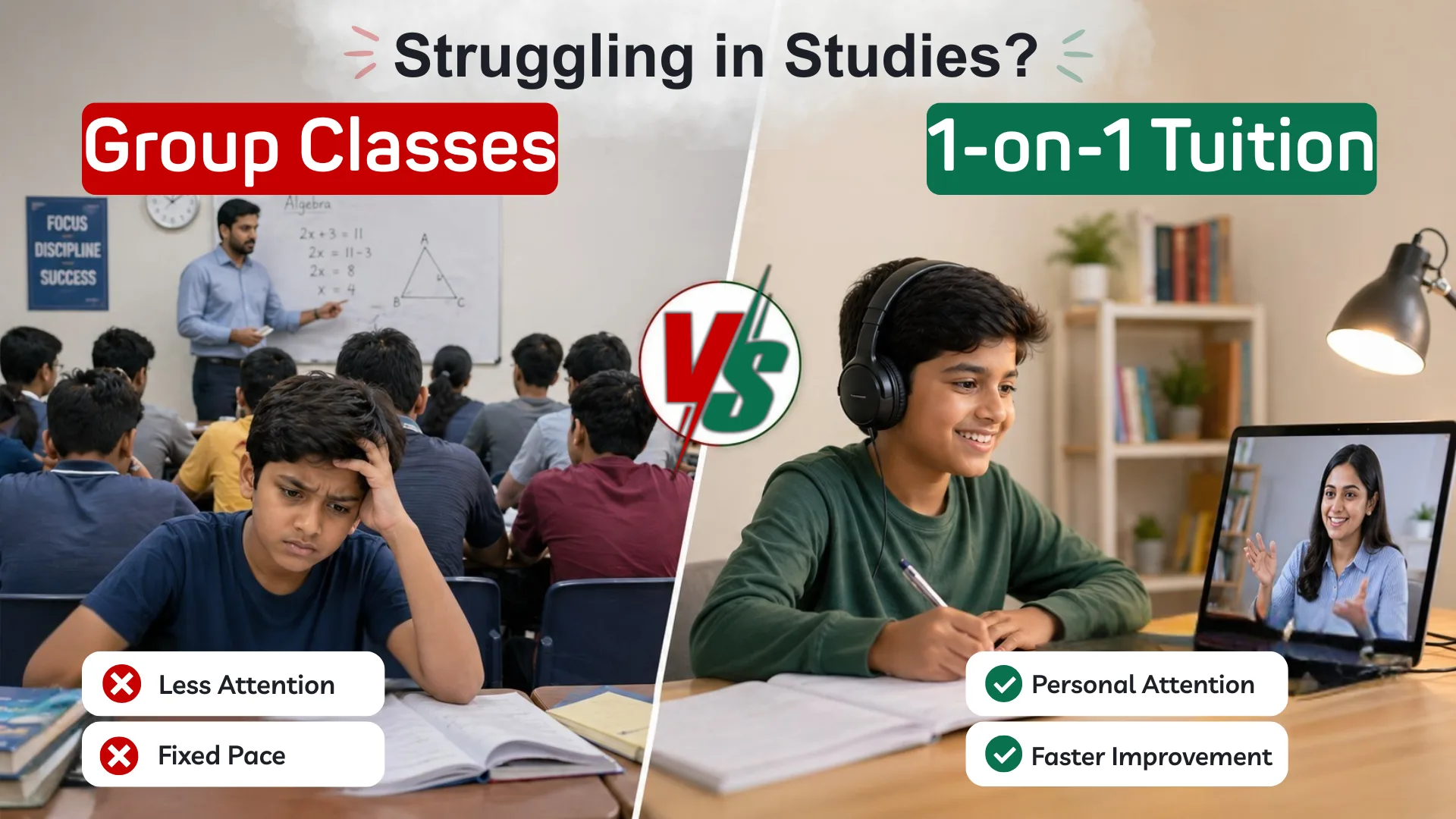
Your child is struggling in Mathematics. You know it. Their teacher has hinted at it. And the report card confirms it. Now you face a decision that sounds simple but carries real consequences: do you enroll them in group tuitions (cheaper, more "social") or 1-on-1 tutoring (expensive, but personalized)? Every parent in India faces this fork in the road. Coaching centers advertise batch sizes of 30 students. Individual tutors offer dedicated attention. Online platforms like ClapsLearn offer structured 1-on-1 sessions. And everyone claims to be the best solution. So what actually works better for struggling students? The honest answer — backed by educational research and tutoring outcomes — is nuanced. Let us break it down.
What 1-on-1 Tuition Actually Means
In 1-on-1 tutoring, one tutor works with one student for the entire session. Every minute is customized to that student's learning pace, gaps, strengths, and questions. Lessons adapt in real time, misconceptions are identified and corrected immediately, and pacing is entirely controlled by the student's needs.
A landmark 2006 study by Professor John Hattie found that 1-on-1 tutoring produces an effect size of 0.79 — nearly double the average learning gain from typical classroom teaching.
What Group Classes Offer — and Where They Fall Short
Group tuitions are the most common form of supplemental education in India. A typical batch has 10 to 40 students, taught by one teacher, following a standardized lesson plan.
Disadvantages for struggling students: The pace is set for the average student, specific gaps are not addressed, students feel embarrassed to ask questions in front of peers, attention is diluted (30 students = approximately 2 minutes per hour of individual attention), and the curriculum is one-size-fits-all.
Head-to-Head Comparison
- Personalization: Full — adapts to student's pace vs None — same lesson for all
- Attention: 100% of tutor's focus vs Shared across batch
- Pacing: Flexible — slow down or speed up vs Fixed — set by teacher
- Gap-filling: Strong — can re-teach old concepts vs Weak — moves with the batch
- Best for: Struggling students, confidence building vs High-performers, enrichment
When 1-on-1 Tutoring Is the Clear Choice
- When Your Child Has Significant Conceptual Gaps — group tuitions cannot help if the group is already moving forward
- When Your Child Has Low Confidence — in 1-on-1, every question is valid and addressed
- When Your Child Has a Specific Learning Difference — dyslexia, ADHD, dyscalculia need individualized approaches
- During High-Stakes Exam Years — Class 10 and 12 require focused, efficient preparation
- When Transitioning Between Boards — CBSE to IB requires adapting to entirely different expectations
The Real Cost Comparison
Parents often avoid 1-on-1 tutoring because of higher per-hour cost. But: Group tuition at INR 500/hour (batch of 10) means your child gets approximately 3 minutes of direct attention per hour. 1-on-1 at ClapsLearn starts at INR 200/hour — your child gets 60 minutes of dedicated, personalized attention.
The Emotional Factor — Often Overlooked
Struggling students in group tuitions often feel embarrassed to admit they do not understand, intimidated by peers, and invisible to the teacher. 1-on-1 tutoring creates a fundamentally different environment: no one to compare yourself to, questions are welcomed, and progress is visible and celebrated.
FAQ: 1-on-1 Tuition vs Group Classes
Is 1-on-1 tutoring worth the extra cost?
For struggling students, almost always yes. The effectiveness of personalized attention consistently outperforms group instruction for students who are behind.
How many hours per week of 1-on-1 tutoring does a struggling student need?
2-3 hours per week of 1-on-1 tutoring in the problem subject(s) is effective as a starting point.
Does 1-on-1 tutoring create dependency?
Not if the tutor is good. The goal is to build your child's independence and confidence until they no longer need the sessions.